In this story · 4 sections
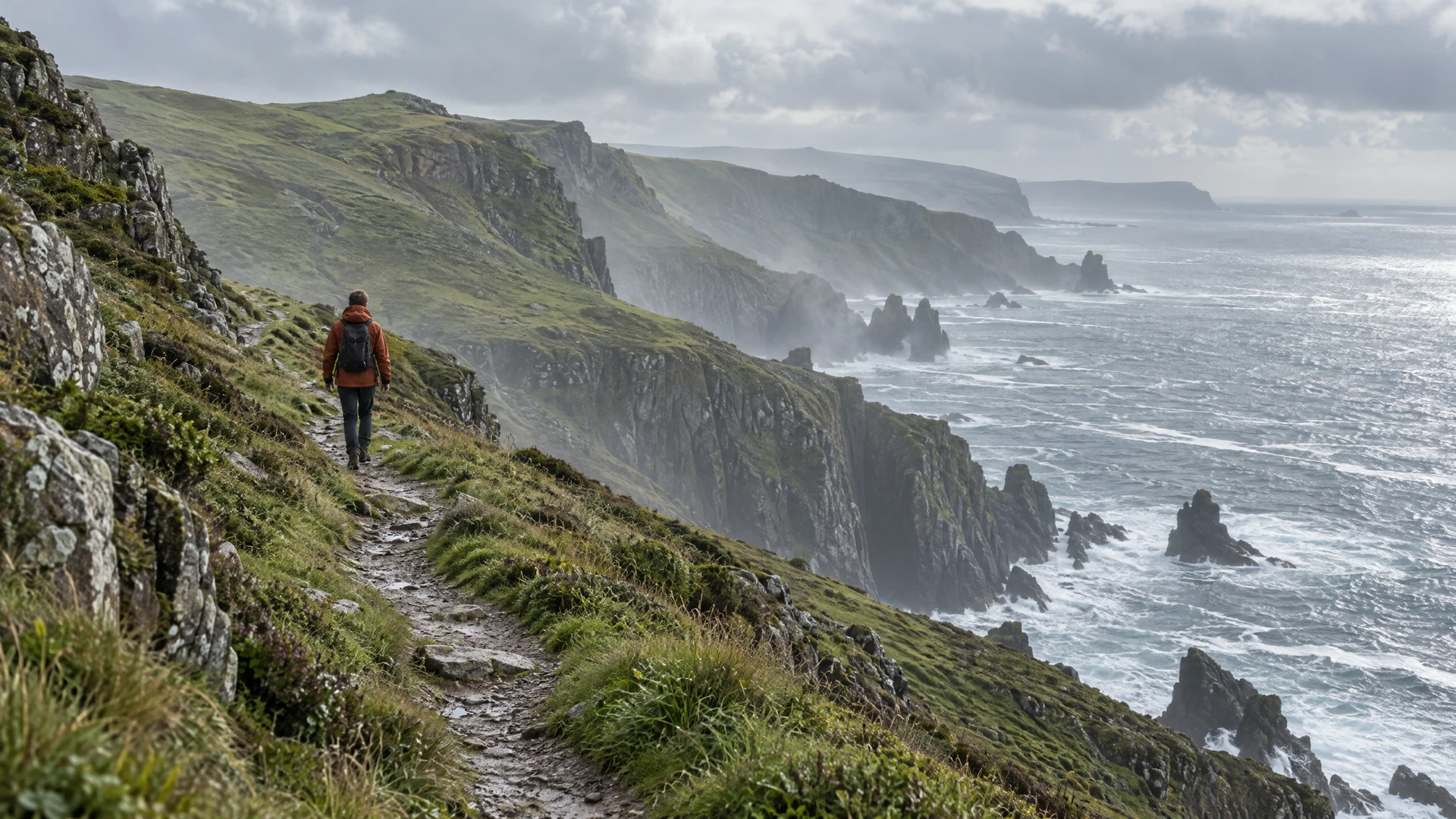
The path begins at a car park with no sign and ends, eight miles later, at a village with one pub. In between there is a lighthouse, a beach accessible only at low tide, and a stretch of cliff that is visibly falling into the sea.
This is not a hike that appears on lists. It has no viewpoint platform, no café halfway, no official trail marker beyond a few faded arrows. It is maintained by a farmer and a volunteer group, and it changes every year.
Walking with erosion
The coast is soft here. Storms take sections of path; walkers report the new route; the farmer moves the fence. The walk is a negotiation with the land, not a fixed product.
That instability is part of the appeal. You cannot walk it on autopilot. You have to look, choose a line, and accept that the map is approximate.
A path that changes is a path that asks for attention.
The local economy
The village at the end has a pub, a shop and a campsite. The walk brings people, but not too many. The farmer is careful about promotion; a path that becomes famous is a path that becomes a problem.
This is a common tension in rural tourism. Visitors want access; residents want quiet; the local economy needs both. The compromise is usually unglamorous: limited parking, no coaches, a donation box.
Practical note
If you go
Check the tide and the weather. Carry water. Do not walk the cliff edge in wind. Take your litter home, including anything that looks compostable. Pay for parking, even when the machine is broken.
The view
There is a point, about five miles in, where the path turns and the whole bay appears. It is not the most spectacular view on the coast. It is the one you have earned.
That is the difference between a destination and a walk. A destination is designed to be photographed. A walk is designed to be experienced, which is a less efficient but more durable pleasure.
The return
The bus back runs twice a day. If you miss it, you wait, or you walk. There is no app for this. There is a timetable on a post, and a pub that will let you sit until it comes.
The cliff path does not try to be convenient. That is why it is worth the trip.



Join the conversation
0 commentsNo comments yet. Add a considered thought — comments are moderated by the editors.