In this story · 4 sections
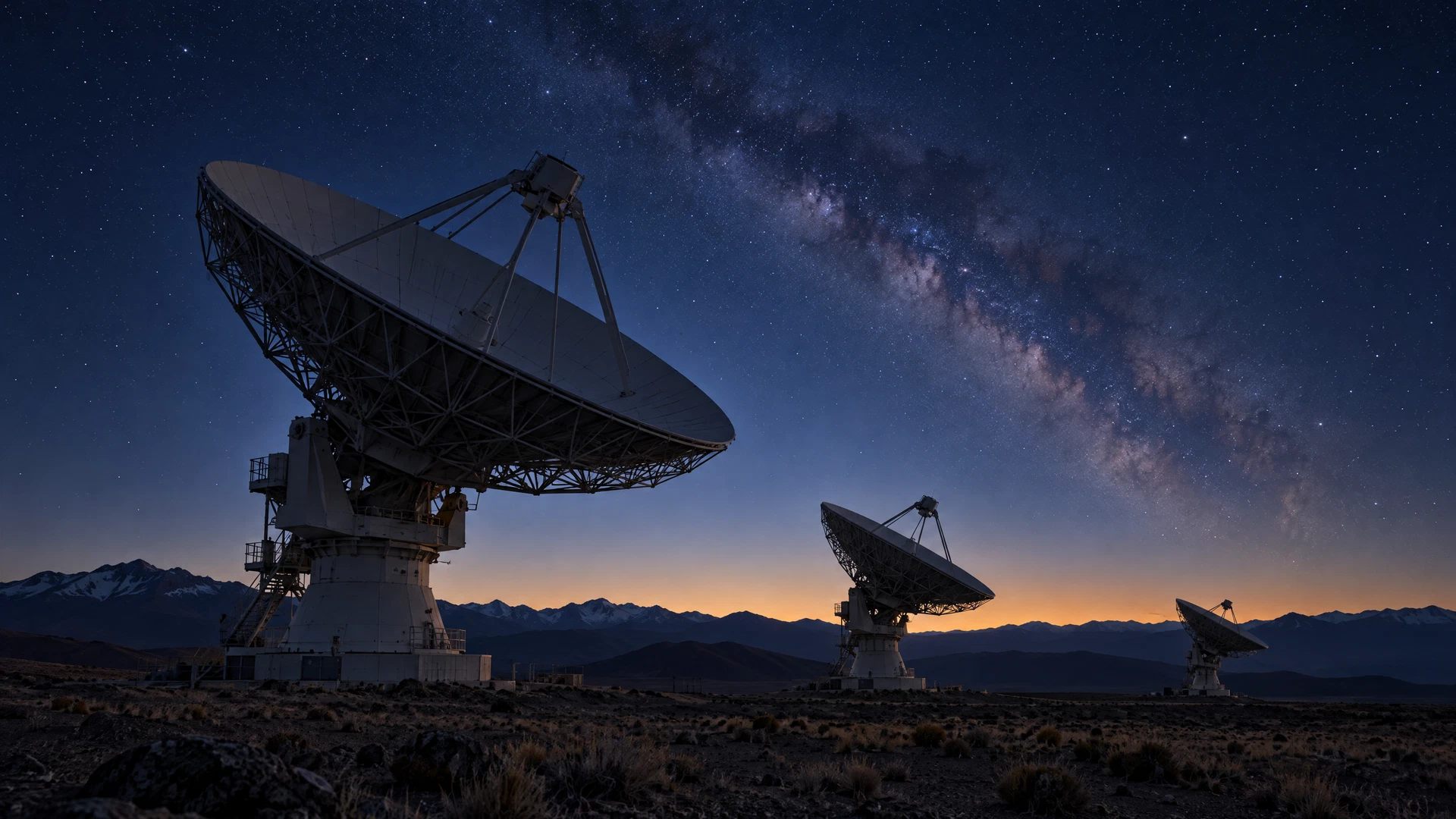
The sky at radio frequencies is not silent. It is full of the residue of everything: pulsars, galaxies, the cosmic microwave background. Somewhere inside that noise is a signal from the cosmic dawn, when the first stars ionised the gas around them.
Finding it requires instruments of extraordinary sensitivity and an environment almost impossible to find on a crowded planet.
What the arrays are looking for
The signal is a faint absorption feature in the spectrum of neutral hydrogen, shifted by the expansion of the universe. It carries information about when the first stars formed and how quickly they changed the gas around them.
The theory is robust. The measurement is brutally difficult. The signal is many orders of magnitude weaker than the foreground radiation, and the foreground must be modelled and removed without removing the thing being measured.
You are trying to hear a whisper in a stadium, and you are not allowed to know which seat the whisper is coming from.
The interference problem
Radio telescopes are protected by regulation, but regulation is not physics. A phone, a microwave oven, a badly shielded laptop charger: all can produce emission in the band being observed. The most remote sites are chosen partly for their silence.
That silence is under pressure. Satellites, in particular, are a growing concern. A constellation designed for connectivity does not intend to interfere with astronomy, but its signals do not stop at the edge of the atmosphere.
Analysis
Engineering as science
A large part of the work is not astronomy but signal processing: flagging interference, calibrating antennas, building software that can handle petabytes without losing the signal in the pipeline.
What success would mean
A detection would not be an image. It would be a statistical shape, extracted from years of data, consistent across instruments. It would tell us about the thermal history of the early universe and constrain models of star formation.
It would also be a reminder that some scientific questions are answered not by a single decisive experiment but by an accumulation of careful ones. The arrays are built to wait.
The human infrastructure
The instruments are international, which makes them political. Funding is shared, data is shared, and decisions about location carry consequences for the countries that host them.
The scientists involved are careful to describe uncertainty. They do not promise a detection date. They promise a better instrument, a cleaner measurement and a result that will be checked by people who would like nothing more than to prove it wrong.




Join the conversation
0 commentsNo comments yet. Add a considered thought — comments are moderated by the editors.